FISH UNJ Geography Lecturers and MGMP Geography DKI Jakarta Strengthen Teachers’ Digital, Disaster, and Research-Based Competencies
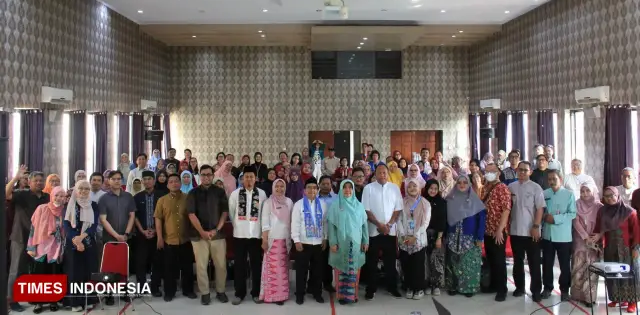
Jakarta, May 8, 2026 — The Geography Cluster of the Faculty of Social Sciences and Law, Universitas Negeri Jakarta (FISH UNJ), in collaboration with the Geography Subject Teachers’ Association (MGMP) of DKI Jakarta Senior High Schools, held a community service program titled “Strengthening Geography Teachers’ Competencies in Digital Technology, Disaster Studies, and Research for Innovative Learning in DKI Jakarta.” The activity took place on Friday, May 8, 2026, at SMAN 2 Jakarta.
The training was attended by 97 senior high school Geography teachers from five administrative areas of DKI Jakarta. This initiative reflects FISH UNJ’s commitment to strengthening teachers’ professional capacity as key actors in improving the quality of education, particularly in Geography learning that is adaptive to technological development, environmental issues, disaster studies, and research-based educational needs.
The program was officially opened by Umaryadi, Head of Institutional Affairs and Learning Resources at the DKI Jakarta Education Office. In his remarks, he emphasized that the activity served as an important effort to enhance teachers’ learning competencies while also encouraging them to produce scientific work as part of their professional and career development.
“This activity is a very positive effort for teachers to improve their learning competencies and scientific writing skills, considering that teachers are currently required to produce scientific work as part of their professional development,” he stated.
Appreciation was also conveyed by Setianingrum, Principal of SMAN 2 Jakarta. She noted that the presence of professors and expert lecturers from FISH UNJ provided both academic reinforcement and motivation for teachers to continue improving the quality of their teaching.
“This activity not only gives us academic encouragement as teachers, but also provides valuable insight because we are guided directly by professors and lecturers with outstanding expertise,” she said.
In the main session, Prof. Muhammad Zid, Professor of Geography at UNJ, delivered a presentation on strengthening teachers’ capacity in scientific writing within the field of Geography. He emphasized that teachers possess valuable classroom experiences, best practices, and teaching reflections that can be developed into scientific articles, educational opinion pieces, and academic publications.
According to Prof. Zid, a culture of writing is an essential part of teacher professionalism. Through scientific writing, teachers do not only document their teaching experiences, but also contribute to the development of knowledge, the improvement of educational quality, and the dissemination of good practices in Geography education.
The training also strengthened teachers’ digital competencies through a session delivered by Fauzi Ramadhoan A’Rachman on the use of Generative AI and Story Maps in Geography learning. In this session, teachers were introduced to the use of generative artificial intelligence to support the preparation of teaching materials, lesson planning, and the development of spatial narratives through more engaging and contextual digital maps.
Meanwhile, Tri Wandi Januar conducted a session on the use of Google Earth Engine in Geography learning. This geospatial technology can help teachers deliver data-driven learning experiences using spatial data, remote sensing, and environmental analysis relevant to disaster issues, regional changes, and sustainable development.
Another session was presented by Lona Syafana Pasya, who introduced the use of NVivo for qualitative data analysis. This training aimed to help teachers manage classroom action research data, learning evaluation materials, and educational research more systematically, credibly, and based on evidence.
Chair of MGMP Geography DKI Jakarta, Denny Mawardi, stated that strengthening teachers’ competencies in digital technology, disaster studies, and research is a strategic step toward creating Geography learning that is more relevant to current developments.
“We hope that Geography teachers in DKI Jakarta will be better prepared to deliver meaningful, up-to-date, and relevant learning experiences for students, while continuing to grow as professionals,” he said.
This community service program also aligns with FISH UNJ’s commitment to supporting the achievement of the Sustainable Development Goals (SDGs), particularly SDG 4: Quality Education, through the improvement of teacher competencies and the promotion of innovative learning. In addition, the focus on disaster studies, geospatial technology, and data-based learning contributes to SDG 11: Sustainable Cities and Communities and SDG 13: Climate Action, as it equips teachers with knowledge and learning tools to better understand regional issues, environmental challenges, disaster risks, and climate change in a more contextual manner.
Through this community service initiative, the Geography Cluster of FISH UNJ reaffirmed the role of higher education institutions in building collaborative networks with schools and teacher communities. The collaboration between FISH UNJ and MGMP Geography SMA DKI Jakarta is expected to serve as a sustainable platform for teachers’ professional development, while strengthening FISH UNJ’s contribution to innovative, humanistic, research-based Geography education that is responsive to the challenges of sustainable development.