Gd. K. Kampus UNJ, Jl. Rawamangun Muka Jakarta Timur
dekan-fis@unj.ac.id
Eurasia International Course 2026 Session 9 Highlights the Role of AI in Transforming Education and Student Skill Development
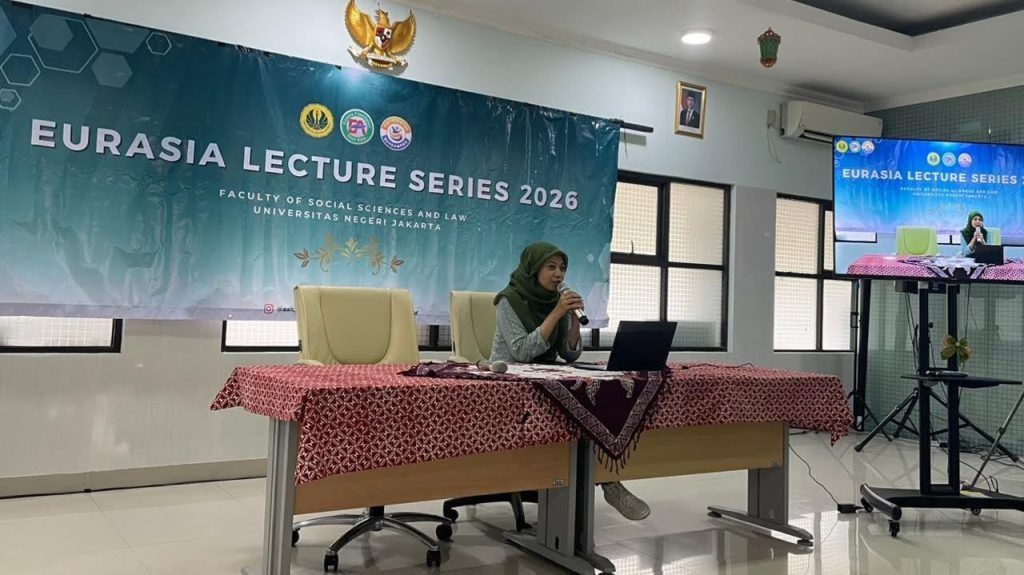
Jakarta, 11 Mei 2026 — The Faculty of Social Sciences and Law (FISH), Universitas Negeri Jakarta (UNJ), successfully held the ninth session of The Eurasia International Course 2026 under the theme “Digitalization and AI Impact on Education and Skill Development.” The session took place on Monday, May 11, 2026, from 1.00 to 3.00 PM in a hybrid format, held onsite at the Multipurpose Room, Building K, FISH UNJ, and online through Zoom.
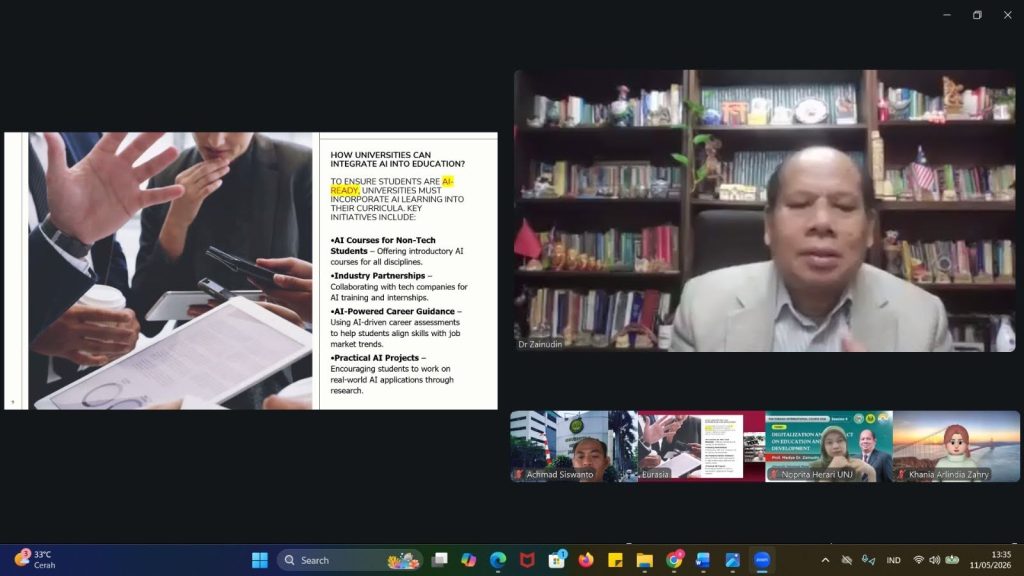
This international seminar featured Prof. Madya Dr. H. Zainudin bin H. Hassan from Universiti Teknologi Malaysia (UTM) as the keynote speaker. The session was delivered in Bahasa Malaysia and English, with Noprita Herari, M.I.Kom. serving as the moderator.
In this session, participants were invited to reflect on how education must adapt to equip students with relevant skills amid the rapid development of digitalization and artificial intelligence (AI). The topic is highly relevant as technological transformation continues to influence not only how people learn, but also the competencies required in the future world of work.
In his presentation, Prof. Zainudin explained that the current labor market is undergoing significant changes due to the advancement of AI. Various industries have begun integrating AI to support job automation, decision-making, data analysis, and overall organizational efficiency. He emphasized that AI can take over tasks that are repetitive, high-risk, speed-oriented, accuracy-based, and require complex computation. However, work that demands creativity, emotional intelligence, adaptability, ethical judgment, and a human touch remains an important space for human contribution.
Prof. Zainudin also highlighted that, according to the World Economic Forum (WEF), the development of AI has the potential to create various new types of jobs, although some conventional roles may shift or disappear. Therefore, AI literacy is no longer an exclusive need for students in technology-related fields, but has become an essential competency across all disciplines. Students from different academic backgrounds need to understand how AI works, how to use it properly, and how to maintain critical thinking when engaging with AI-based technologies.
Furthermore, Prof. Zainudin emphasized that AI should not be seen as a threat to education, but rather as an opportunity to build a more adaptive, inclusive, and personalized learning system. AI can assist educators in handling administrative tasks, analyzing students’ learning progress, and providing more targeted learning support. This allows educators to focus more on aspects that cannot be replaced by machines, such as character building, creativity, ethics, communication, and emotional intelligence.
The session also featured an interactive question-and-answer discussion. Abel Elysia from the Sociology Education Study Program raised a question about the use of AI and its impact on the climate crisis. In response, Prof. Zainudin explained that energy efficiency is an important concern for the future, not only because of AI usage, but also as part of a broader sustainability responsibility. He shared that UTM has implemented a work-from-home policy for all faculty members every Tuesday and Thursday as one of the efforts to support energy efficiency.
Another question came from Marco from the Communication Science Study Program, who asked how AI does not only replace jobs but also creates new ones, including its relation to intellectual property and the field of arts. Prof. Zainudin responded that although AI can support many kinds of work, humans continue to play a central role in producing creativity, knowledge, and critical judgment. He also reminded participants that tools such as ChatGPT should be used to test and support knowledge, not to be followed entirely without critical reflection.
Through The Eurasia International Course 2026, FISH UNJ continues to strengthen international academic exchange that is relevant to current global challenges. This session reaffirmed the importance of synergy between technology and human capabilities in responding to educational transformation in the digital era. The discussion was conducted interactively and attended enthusiastically by participants from various academic backgrounds, both onsite and online.
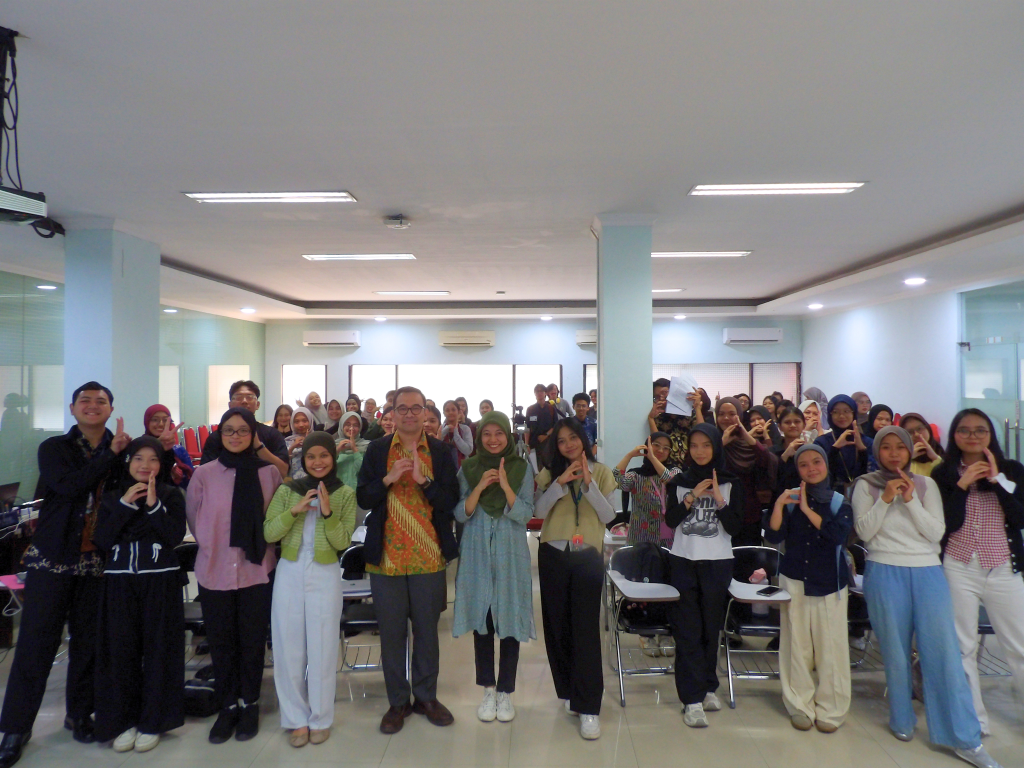
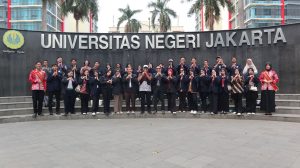
The activity concluded with a group photo session featuring the Intelligentia Dignitas UNJ hand sign as a symbol of academic collaboration, togetherness, and FISH UNJ’s commitment to promoting adaptive, human-centered, and future-ready education in response to technological development.