Gd. K. Kampus UNJ, Jl. Rawamangun Muka Jakarta Timur
dekan-fis@unj.ac.id
Eurasia International Course 2026 Discusses the Use of Artificial Intelligence (AI) and Robotics in Inclusive Education
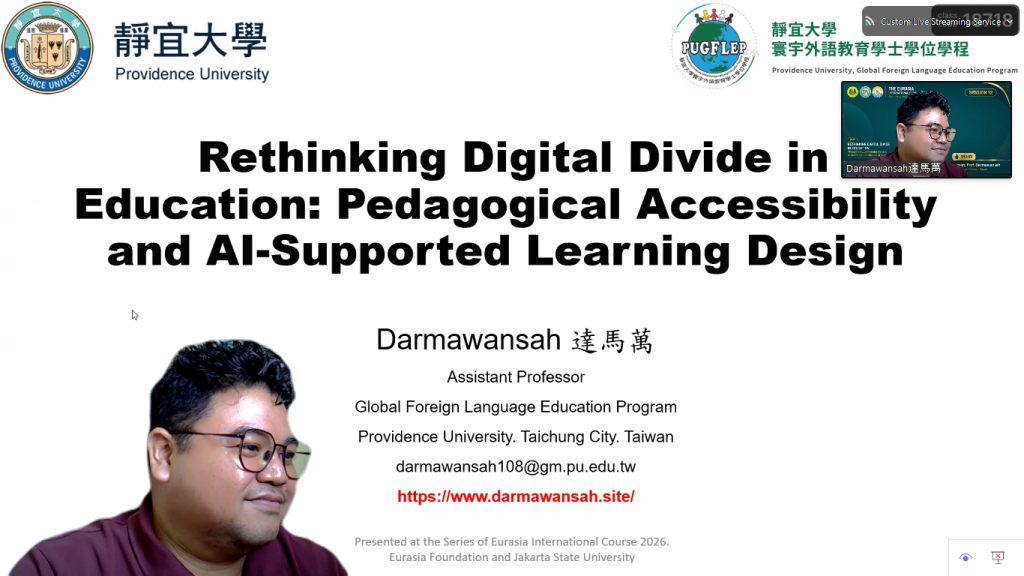
Jakarta, June 1, 2026 – Eurasia International Course 2026 once again held an international online learning session via Zoom entitled “Rethinking Digital Divide in Education: Pedagogical Accessibility and AI-Supported Learning Design.” The session featured Assist. Prof. Darmawansah from the Global Foreign Language Education Program, Providence University, Taichung City, Taiwan, as the speaker, with Fajar Aditya Nugroho serving as the moderator.
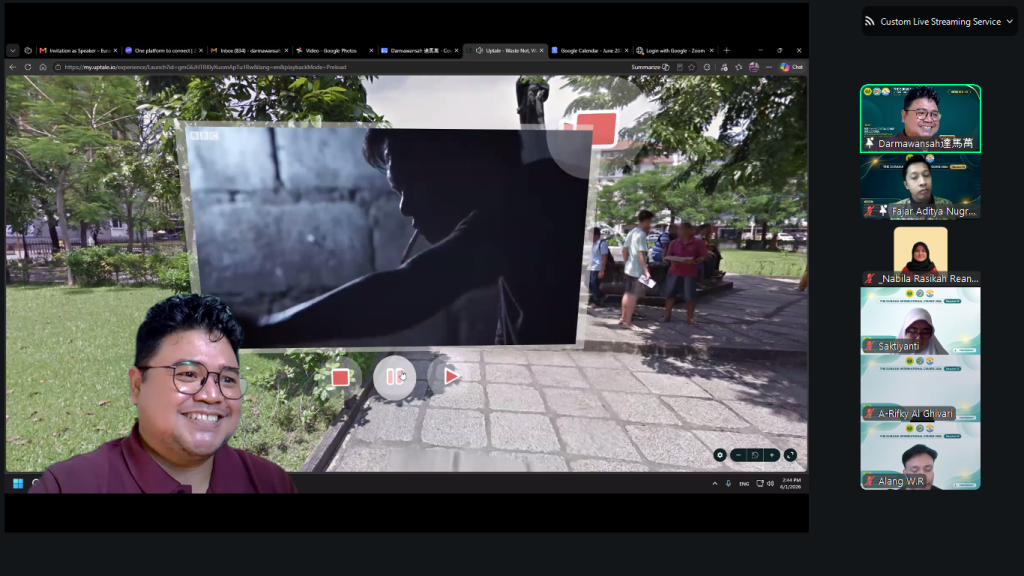
The session began with an opening by the moderator, who introduced the speaker’s academic background and career journey as an Indonesian scholar currently teaching in Taiwan. Following the introduction, the speaker invited participants to engage in an interactive discussion using ClassPoint, a platform he frequently utilizes in his teaching activities. Through the platform, participants shared their experiences using various AI tools, including ChatGPT, Gemini, Perplexity, and others.
During his presentation, Assist. Prof. Darmawansah explained that artificial intelligence is not merely a tool for accessing information, but can also support more effective learning processes. He emphasized that the use of AI should be accompanied by human capability to manage and collaborate with technology. “AI can improve performance, AI is good for learning, but AI will be nothing without collaboration with people,” he stated.
In addition to discussing various AI tools that can be utilized for design and educational purposes, the speaker also highlighted the role of immersive learning technologies, such as virtual reality (VR) and the metaverse. These technologies are designed to create more interactive and collaborative learning experiences, while also increasing student engagement in understanding educational content.
In the following session, Assist. Prof. Darmawansah introduced the use of educational robots as learning media. One example presented was the Kebbi Robot, which can interact with students through conversations, quizzes, and storytelling activities. The robot is designed to help enhance students’ communication skills, creativity, and computational thinking abilities.
According to him, technology should be used to support meaningful learning processes rather than merely following technological trends. He emphasized that educators do not always need to develop technology from the beginning, but should be able to adapt technology to learning needs. Therefore, the use of technology should be combined with appropriate instructional design.
Closing the session, Assist. Prof. Darmawansah expressed his hope that the educational robots currently being developed could eventually be implemented in Indonesia. Beyond serving as interactive learning media, these robots could also be utilized for digital storytelling that promotes Indonesia’s local culture.
Together with one of his students from Medan, he is currently developing a robot-based learning concept centered on the Indonesian legend of Malin Kundang. Through this program, the robot can move, speak, and follow a programmed storyline, allowing students to learn about technology while simultaneously exploring Indonesian culture in a more engaging and interactive way (NRR/NJNA/CKG/FISHMed2026).