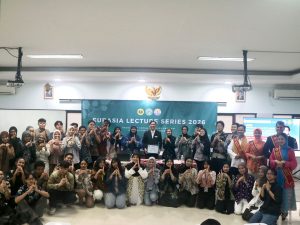
UNJ EURASIA 2026 ADVANCES THE INTERNATIONALIZATION OF FISH UNJ THROUGH DISCUSSIONS ON DIGITAL TECHNOLOGY FRAMEWORKS IN DIGITAL SOCIOLOGY
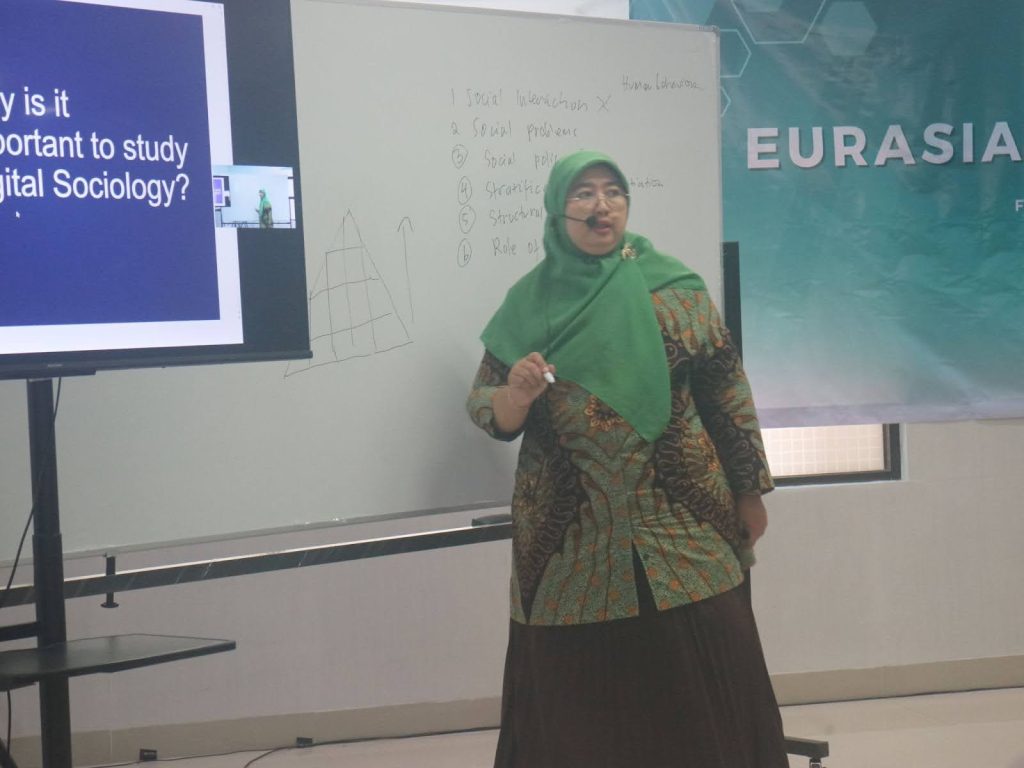
Jakarta, March 9, 2026 — The Faculty of Social Sciences and Law of Universitas Negeri Jakarta (FISH UNJ) held The Eurasia International Course 2026 – Session 2 with the theme “Theoretical Framework in Digital Sociology.” The session featured Dr. Rusfadia Saktiyanti Jahja, M.Si., Coordinator of the Sociology Study Program at UNJ, as the main speaker. She presented various theoretical perspectives to understand how digital technology shapes social interactions, identity formation, and the dynamics of contemporary society.
In her presentation, Dr. Rusfadia explained that the rapid development of digital technology has significantly transformed the ways people interact, communicate, and build social relationships. Therefore, the study of digital sociology has become increasingly important for examining the broader social implications of technological change. According to her, digital sociology not only studies the use of technology but also analyzes how technology influences social structures, communication patterns, and the construction of identity within digital spaces.
Dr. Rusfadia menekankan beberapa alasan penting mengapa sosiologi digital perlu dipelajari. Pertama, untuk memahami dampak teknologi terhadap masyarakat secara luas. Kedua, untuk mengkaji perubahan pola interaksi sosial dan ruang sosial yang kini banyak terjadi di dunia digital. Ketiga, untuk mempelajari fenomena-fenomena baru yang muncul di ruang digital seperti hoaks, perundungan siber (cyber bullying), dan kejahatan siber (cybercrime). Keempat, kajian ini juga penting dalam proses perumusan kebijakan publik agar mampu merespons perubahan sosial yang dipicu oleh perkembangan teknologi.
Beyond discussing the urgency of digital sociology, Dr. Rusfadia also elaborated on several structural changes occurring within digital societies. One of the most visible transformations can be seen in family institutions. She noted that digital technology has facilitated communication among family members, particularly through video calls and instant messaging applications that allow individuals to maintain relationships despite geographical distance.
Similar changes are also evident in the world of work. Dr. Rusfadia explained that technological advancements have enabled the emergence of remote work systems, which have reshaped conventional workplace dynamics. Employees are no longer required to be physically present in offices to complete their tasks. In addition, the growth of digital platforms has given rise to the gig economy, an economic system characterized by short-term, project-based employment facilitated by digital platforms. Within this system, individuals can take on temporary jobs without being tied to permanent employment contracts.
In the field of digital sociology, Dr. Rusfadia also highlighted several key concepts that have become important research focuses. One of these is the issue of access to information. She explained that information poverty is not merely related to the ownership of technological devices but also concerns individuals’ ability to access, process, and utilize information effectively.
Another concept discussed was the digital public sphere. In this context, Dr. Rusfadia referred to the ideas of sociologist Colin Sparks, who emphasizes two essential elements of a public sphere: guaranteed access for all citizens and the right of individuals to negotiate and participate freely in public discourse.
Towards the end of her presentation, Dr. Rusfadia emphasized the growing importance of big data analysis in contemporary social research. Big data generally refers to large-scale datasets that are diverse, complex, and often unstructured. While big data analysis methods were initially developed in the natural sciences, they are now widely applied across various sectors, including business, the video game industry, and social sciences.
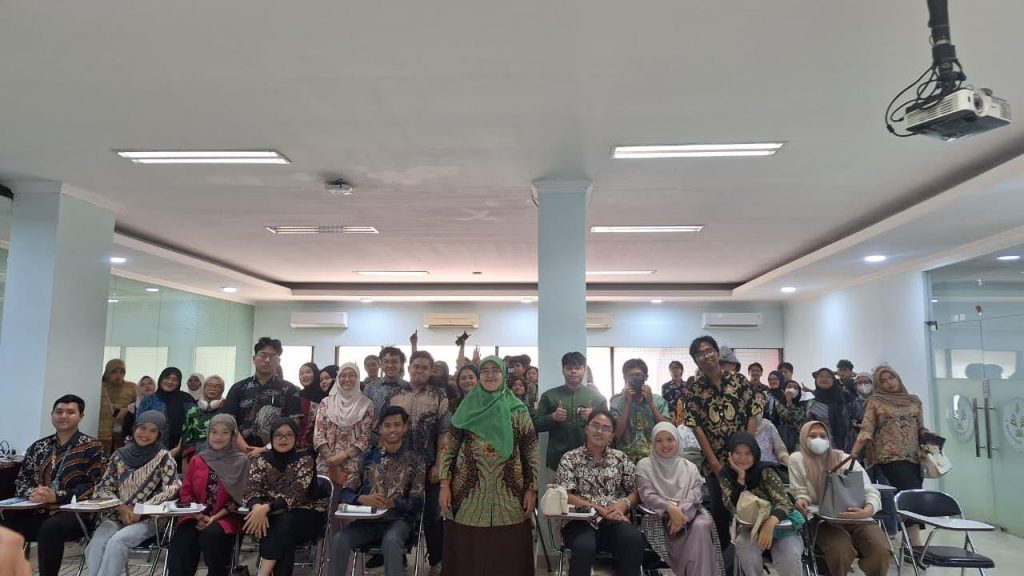
The Eurasia International Course 2026 – Session 2 is expected to broaden the understanding of students and academics regarding the development of digital sociology and its implications for social life in the era of technological transformation. The discussion also provided a platform for knowledge exchange on how social sciences can adapt to rapidly evolving digital technologies.